In short
Michael Chekhov, nephew of the author of The Seagull and a pupil of Stanislavski, built character through the body and the imagination rather than through the actor's own memories. His best-known tool, the psychological gesture, condenses a whole role's drive into a single movement.
- The psychological gesture: one complete movement of the whole body, worked on in rehearsal, then internalised and never shown to the audience.
- No personal excavation: feeling is provoked by indirect means, the imaginary body, atmospheres, qualities of movement.
- To the Actor (1953): the book of the technique, little theory and progressive exercises, to practise alone or in a group.
- Today: an international association, studios in Europe and the United States, and a revival among screen actors.
Of the teachers who came out of Stanislavski's studios, Michael Chekhov is the one who took the least expected turn. Where the American branches dug into the actor's personal history, Chekhov routed character through the body and the imagination, and asked a question the others largely avoided: what if the way into a role is not remembering, but moving?
Who was Michael Chekhov?
Michael Chekhov (1891-1955), nephew of the playwright Anton Chekhov, was a Russian actor and teacher who trained at the Moscow Art Theatre under Stanislavski. He went into exile in 1928 and taught in Europe and then the United States, at Dartington Hall in England (1936-1938), in Connecticut, and finally in Hollywood.1
Before he left, he was regarded as one of the most striking actors of his generation in Russia, with a celebrated Hamlet, and he ran the Second Studio of the Moscow Art Theatre. His teaching career was then built country by country, often in languages he was learning while he taught in them.2 In Hollywood he played the analyst in Alfred Hitchcock's Spellbound (1945), a part that earned him an Academy Award nomination for Best Supporting Actor, and he trained film actors until his death. A whole life spent passing the work on led to one book, To the Actor, published in 1953.1
What is the psychological gesture?
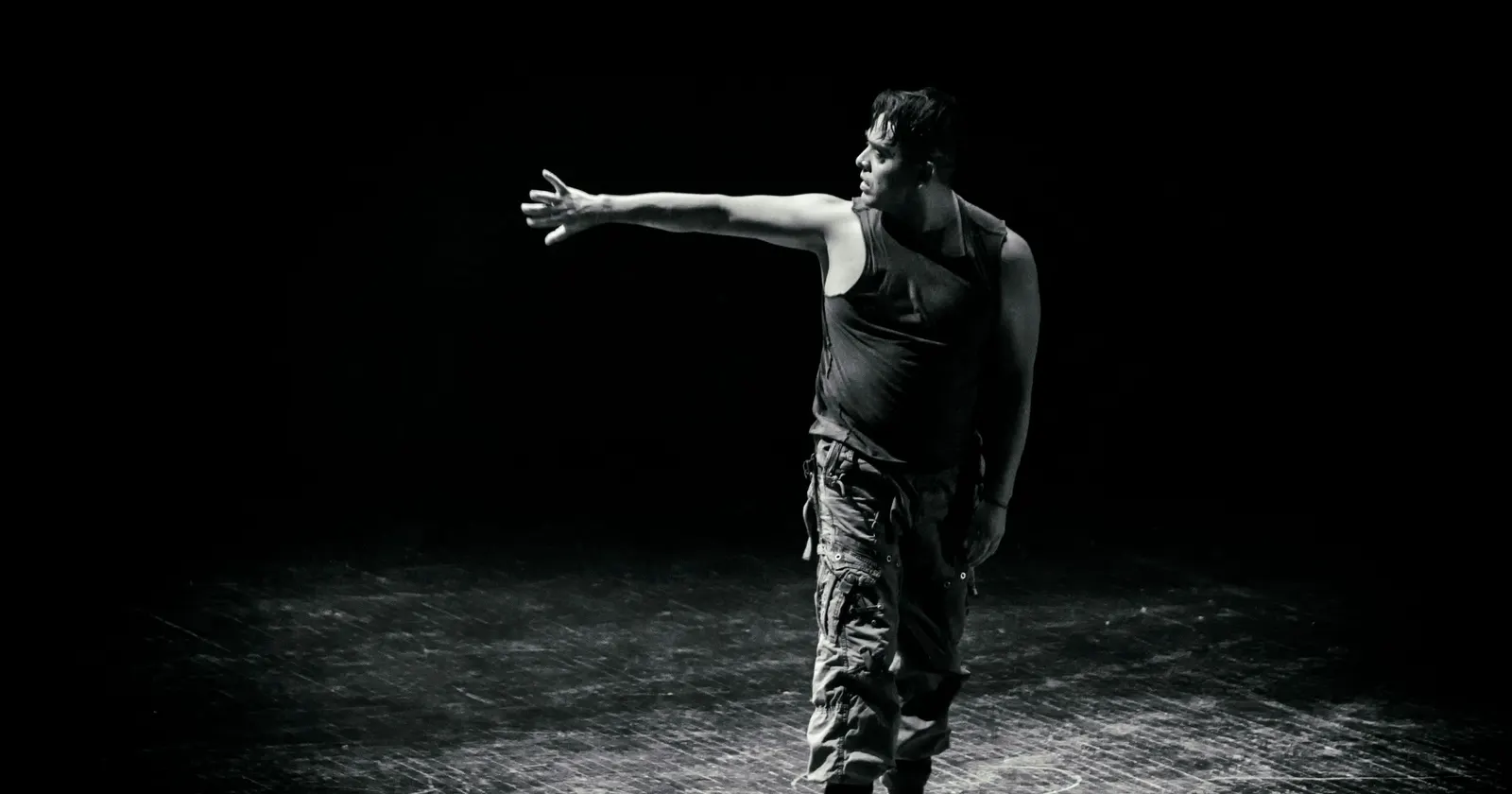
The psychological gesture condenses the whole drive of a character, what they want, what pushes them, into a single complete movement of the entire body. The actor works on it in rehearsal, away from the scene, large and complete, then internalises it: it is never shown to the audience, it feeds the performance from the inside.3
The premise is that a want has a shape. A character consumed by ambition might condense into a tearing movement upwards, a character who refuses everything into a movement of closing and pushing away. The gesture is repeated, refined, made precise in direction, speed and quality, until the body knows it. After that, according to Chekhov, simply evoking it inwardly, even standing still, is enough to rekindle the state it holds.
The tool reverses the usual route: instead of looking for an emotion and letting it reach the body, the body offers a form and the emotion comes to inhabit it. It is a technical path, repeatable from one performance to the next, which explains its success with stage and screen actors alike. It also needs no partner, so it slots easily into the routine every actor builds between jobs.
Why does the technique keep the actor's personal life out?
Chekhov wrote: "We cannot directly command our feelings, but we can provoke them by certain indirect means."3 Those means are the imagination and the body, never the actor's private memories.
Where other teachings from the same source draw on personal memory, like the affective memory that Stanislavski's early system put at its centre, Chekhov built everything on the imagination. The imaginary body invites the actor to play with the character's dreamed body rather than their own, atmospheres give the space of the scene a sensory colour, qualities of movement tint every action. The actor stays protected: their own wounds are not the raw material of the work. That position has made the Chekhov technique a frequent reference in today's conversations about performers' wellbeing.6
What does To the Actor (1953) contain?
To the Actor gathers the technique into a dozen chapters of exercises: the body and psychology, imagination, atmosphere, the psychological gesture, the composition of the character and of the performance.3 An earlier Russian version existed, and a complete edition, On the Technique of Acting, was restored after his death.5
The book stands apart from the acting classics in its form: little theory, numbered and progressive exercises, designed to be practised alone or in a group. There is no inventory of childhood memories, no instruction to excavate old griefs, which made it portable across languages and traditions. The 2002 Routledge edition carries a foreword by Simon Callow.4 The text is still in print and still on the syllabus of many drama schools.
Who claims the technique today?
His direct students included Yul Brynner and Beatrice Straight, and Marilyn Monroe worked with him in Hollywood.1 The technique is passed on today by dedicated associations, among them the Michael Chekhov Association (MICHA), founded in the United States in 1999, and taught in studios across Europe and North America.8
Anthony Hopkins has spoken publicly, more than once, about his debt to this work. Research has started to take an interest too: a study published in Frontiers in Psychology in 2019 measured the effect of Chekhov exercises on participants' mood, more pleasant after expanding gestures, more aroused after contracting ones.7
In France the technique remains less known than those of its Group Theatre contemporaries, but it is gaining ground in workshops and continuing training, often through its most concrete tool, the psychological gesture. To place this approach among the other great acting traditions, from Stanislavski to Brecht, our map of acting techniques and methods covers the full landscape.
Sources
- Michael Chekhov, Wikipedia, accessed November 2026
- Michael Chekhov: Teaching (Acting) in a Foreign Land, Liisa Byckling, Critical Stages, December 2011
- To the Actor: On the Technique of Acting, Michael Chekhov, Harper & Brothers, 1953
- To the Actor: On the Technique of Acting, Michael Chekhov, edited by Mala Powers, foreword by Simon Callow, Routledge, 2002
- On the Technique of Acting, Michael Chekhov, HarperCollins, 1991
- Discovering the Michael Chekhov Acting Technique, PerformInk
- Embodied Cognition in Performance: The Impact of Michael Chekhov's Acting Exercises on Affect and Height Perception, Olenina, Amazeen, Eckard and Papenfuss, Frontiers in Psychology, 2019
- Michael Chekhov Association, official site
Frequently asked questions
Is the psychological gesture shown to the audience?
No. The gesture is done large in rehearsal, until the body knows it, and is then internalised. In performance, evoking it inwardly is enough to find the state it holds again, and the audience only sees what it colours.
How is the Chekhov technique different from Strasberg's Method?
Both come from Stanislavski, but they start from opposite places. Lee Strasberg's Method relies on affective memory, the actor's personal recollections. Chekhov works through the imagination and the body, and leaves the actor's private life out of the work.
Which book should you start with to discover the Chekhov technique?
To the Actor, published in 1953, is still the way in: short chapters, each followed by progressive exercises. On the Technique of Acting, published after his death, gives the complete version. The exercises make more sense once practised with a teacher trained in the technique.
Read next
Follow what we publish: @join_acto on Instagram.