
In short
There is not one acting method but half a dozen, nearly all descended from the "system" Stanislavski built at the Moscow Art Theatre. They share the same goal, truthful acting that can be repeated night after night, and part ways over where the work begins.
- Stanislavski: a set of tools, given circumstances, units, objectives, which itself moved from emotional memory towards physical action.
- The American Method: three rival teachings since 1934, memory for Strasberg, imagination for Adler, the partner for Meisner.
- The body and distance: Michael Chekhov's psychological gesture, movement with Lecoq, Brecht's distancing effect.
- In France: no dominant method, teaching passed on through schools and individual masters, and a vocabulary that often arrives in English.
The word "method" is everywhere in acting classes, and almost always in the singular, as if there were only one. In fact there are half a dozen in circulation, they do not say the same thing, and several contradict each other on the very starting point of the work.
This article is a map, not a ranking. Each approach is described for what it proposes, with its dates and its texts. There is no winner, and most working actors borrow from several without necessarily naming them.
Where does the idea of a method come from?
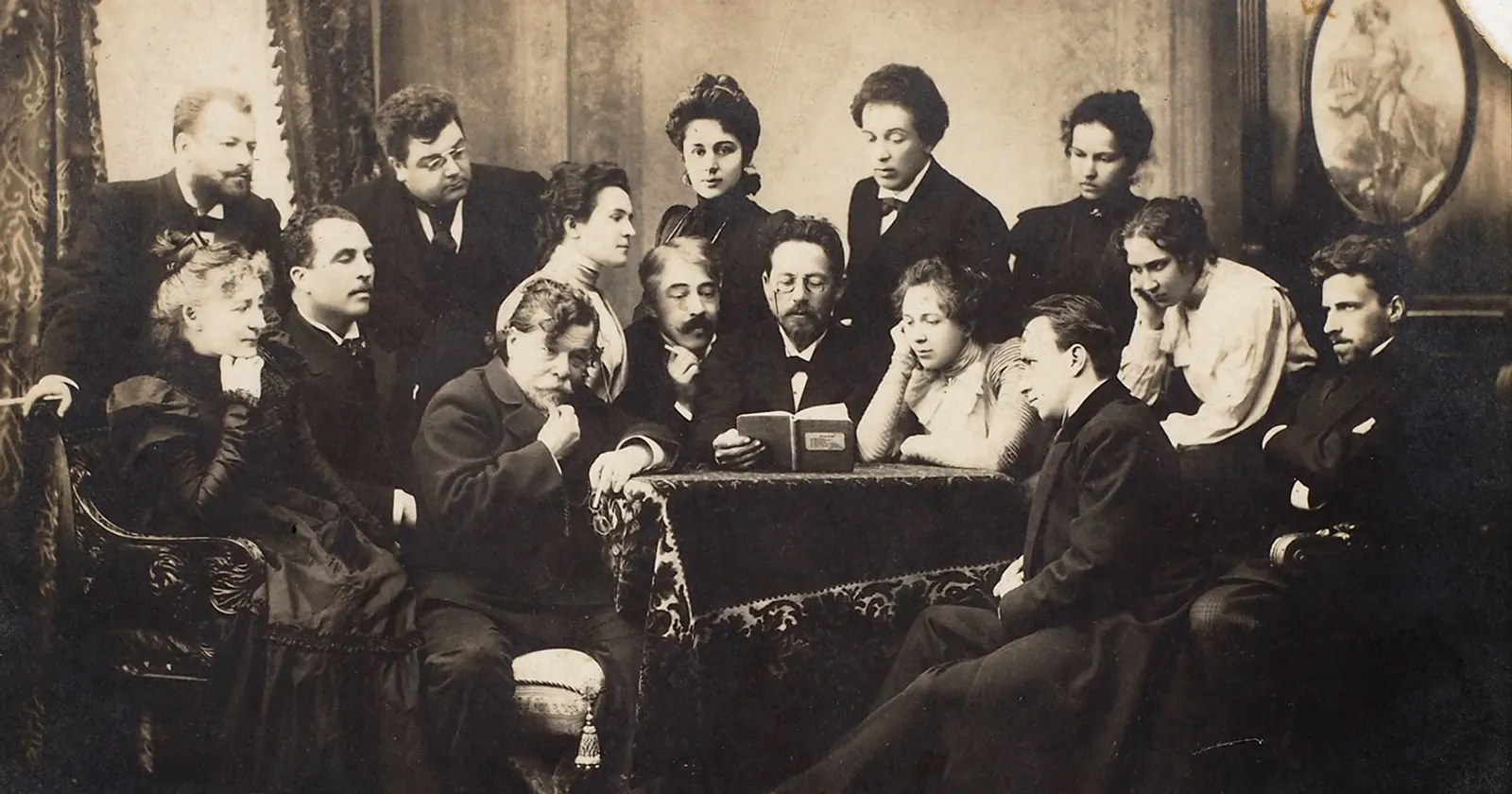
The idea that acting can be worked on systematically dates from the end of the nineteenth century. Konstantin Stanislavski, a Russian actor and director, co-founded the Moscow Art Theatre, which opened in 1898, and spent forty years there building what he called his "system", the first attempt to organise how a role is prepared.2
Before him, acting was mostly learned by imitation: you watched your elders, borrowed their effects, inherited stock types and conventions. Stanislavski was after something else, a way to make acting truthful in a repeatable way, night after night, instead of waiting for inspiration to strike.
The system did not stay a Russian affair. Translated, taught and transformed, it became the common root of nearly everything that presents itself today as an acting method. The approaches that follow descend from it, oppose it, or argue with it.
What did Stanislavski's system propose?
The system starts from a working question: what would the person playing do if they found themselves in the character's circumstances? Around that question Stanislavski organised a set of tools, given circumstances, division into units, objectives, which still make up the everyday vocabulary of scene analysis.2
Two things set it apart from the methods that followed. First, it changed during its author's lifetime: having started from emotional memory, Stanislavski ended, from the late 1920s, with an approach built on physical action, entering a scene through what the character does rather than what the character feels. Several accounts of the period, including the American Theatre piece cited below, connect that shift to growing Soviet pressure on introspective artistic work.3 Second, it presents itself as a toolkit to be tested, not as a closed doctrine.
That path has a consequence most course pages leave out. Students who left in the 1920s did not carry away the same system as those who worked with him at the end. When they opened schools of their own, each taught what they had received, in good faith, and those schools ended up defending incompatible positions in the same man's name.
What is the American Method, and why did it split three ways?
The Method, with a capital M, is the American branch of the system. After the Moscow Art Theatre toured the United States in the early 1920s, two of its alumni, Richard Boleslavsky and Maria Ouspenskaya, stayed in New York and founded the American Laboratory Theatre, where Lee Strasberg trained. In 1931 he co-founded the Group Theatre.4 The Method was then passed on, notably at the Actors Studio, founded in 1947, and split into three distinct teachings: those of Lee Strasberg, Stella Adler and Sanford Meisner.1
Strasberg kept affective memory from the early Stanislavski: the actor draws on their own recollections to supply the emotion of the role. That is the teaching that gave the Method its reputation, its film stars, and the stories of extreme preparation that circulate about it. He carried it on at the Actors Studio, where he became artistic director in 1951.
Adler, for her part, worked directly with Stanislavski in Paris in 1934 and came back with a clear disagreement: the old master himself no longer started from personal memories, and Strasberg had overemphasised that one tool. Her teaching rests on imagination and on the circumstances of the play, not on the biography of the person playing. The Group Theatre never entirely recovered from the quarrel, and closed in 1941.3
Meisner, also from the Group Theatre, moved the starting point again: neither memory nor imagination alone, but the other person. His repetition exercises, taught at the Neighborhood Playhouse in New York, train actors to respond truthfully to what their partner is doing, moment to moment. His definition of acting fits in one sentence: living truthfully under imaginary circumstances.7
Three schools, three answers, one common ancestor. In practice the map is less tidy than it looks. Jackson Davis, writing in Backstage, points out that the exercises have been circulating between these schools for seventy years, and that a class advertised as Meisner may well include circumstance work Adler would have signed.5
Then there is the press usage. When a profile calls someone a "method actor", it is describing conduct on a set (staying in character between takes, changing their body for a part), not a syllabus. None of the three schools set out to produce that behaviour, and much of the confusion around the word comes from the gap between the two usages.
What does Michael Chekhov propose?
Michael Chekhov, nephew of the playwright and an actor trained under Stanislavski, took a direction his teacher did not: working through the body and the imagination rather than through personal life. His best-known tool, the psychological gesture, condenses a character's inner drive into a full movement of the body.6
The idea is almost the reverse of Strasberg's. Where affective memory digs into the actor's own experience, the psychological gesture builds the character from a physical form, which the body memorises and the performance can then internalise. Chekhov left the Soviet Union in 1928, taught in Europe and then the United States, and his reference book, To the Actor, was published in 1953.
Because it was never tied to a single institution, the approach long circulated quietly, carried by specialist studios. Over the last twenty years or so it has seen a clear revival, notably among screen actors looking for a technical route to emotion that does not call on their own history. His writings entered the public domain in 2026, seventy years after his death.
And Brecht, at the opposite end?
Bertolt Brecht takes the reverse position: where Stanislavski's heirs seek identification, he refuses it. His distancing effect asks the actor to show the character rather than merge into it, so that the audience keeps enough distance to think about what it is watching.
In concrete terms, Brechtian acting owns up to being acting. It quotes the character, almost comments on it, and deliberately breaks the illusion when it settles in too comfortably. This is not a rejection of the work but a different kind of work: precision, clarity, awareness of what each gesture says socially.
Distancing is taught less as a complete method than as an undercurrent, in contemporary writing, in documentary theatre, anywhere a performance points to itself. Most actors run into it at some point, often without having chosen to.
Why does France have no dominant method?
The French tradition was built differently, through masters, texts and schools, without any single system taking over. The conservatoires and the national drama schools, the first of the three doors described in what "professional actor" actually covers, teach through interpretation, scene classes, scene work and apprenticeship with directors, more than through a named doctrine.7
The most visible exception is physical: the school Jacques Lecoq founded in Paris in 1956 trains through movement, the neutral mask and the body, and its influence reaches well beyond France.8 But it trains theatre makers more than it equips the analysis of a role.
That is one reason why, in France, the vocabulary of the methods circulates mostly in English, or in translation. Objective, stakes, circumstances: the words have entered the classroom, often detached from the systems that coined them.
What do these approaches have in common?
They all answer the same question by different routes: where does truthful acting start? The disagreement is almost never about the goal; it is about the starting point. That is what makes the map readable. Each method comes down to where it makes the work begin.
- Strasberg starts it in the actor's memory.
- Adler in the imagination, fed by the circumstances of the play.
- Meisner in the partner, watched closely enough.
- Michael Chekhov and Lecoq in the body, before the words.
- Brecht in the way the character is looked at, from a deliberate distance.
Knowing these names is mostly useful in the rehearsal room, to hear what a note is asking for. A note asking what the character wants is speaking the language of objectives. A note asking what is coming from the other actor is Meisner's. An image or a shape to try is on Chekhov's side of the map. The vocabulary says what kind of adjustment is wanted, which is more use in the moment than knowing where the person trained.
A century of schools has not closed the question, and the disagreements between them have stayed public, from Adler against Strasberg to the reservations French teachers have long voiced about the Method. There are as many ways to approach a role as there are teachers, and that is the state of the profession, not an anomaly.
After drama school, it is often alone that these vocabularies mix the most. In the routine every actor builds between two projects, a warm-up comes from one teacher, a listening exercise from another, without anyone always knowing which lineage they belong to.
Sources
- Method acting, Wikipedia, accessed September 2026
- Stanislavski's system, Wikipedia, accessed September 2026
- The Given Circumstances of "The Method", Rob Weinert-Kendt, American Theatre, February 2022
- Group Theatre (New York City), Wikipedia, accessed September 2026
- There Is No Such Thing as a Meisner, Adler, Strasberg, or Hagen Technique or Method, Jackson Davis, Backstage
- Les méthodes d'interprétation des grands maîtres du théâtre : Stanislavski, Meisner et Michael Chekhov, La Librairie Théâtrale (in French)
- Méthodes de jeu d'acteur : Stanislavski, Meisner, Actor Studio et techniques essentielles, Cours Le Foyer (in French)
- History of the school, École internationale de théâtre Jacques Lecoq
Frequently asked questions
What is the difference between Stanislavski's system and the Method?
The system is the set of tools Stanislavski built at the Moscow Art Theatre and kept revising for some forty years, moving from emotional memory towards physical action. The Method is its American offshoot, born at the Group Theatre in the 1930s. In Lee Strasberg's teaching, it mainly kept the early period, the one built on affective memory.
What does "method actor" mean?
In the press, the phrase describes a behaviour: staying in character between takes, transforming one's body for a role. In acting schools, the Method refers to a specific teaching, that of Lee Strasberg and his heirs. The two usages have drifted apart, and none of these schools teaches that behaviour as a goal.
Which acting method is taught in France?
None dominates. French conservatoires and national drama schools teach through interpretation and scene work, with the directors who teach there, rather than through a named doctrine. The best-known exception is the Jacques Lecoq school, founded in Paris in 1956, which trains through movement and the mask.
Read next
Follow what we publish: @join_acto on Instagram.