
In short
The Meisner technique is the approach to acting Sanford Meisner built at the Neighborhood Playhouse in New York from 1935 onwards. It moves the source of acting outside the actor, into what the scene partner is doing, and trains it first through an exercise with no written text at all.
- A definition: "living truthfully under imaginary circumstances", and the reality of doing rather than the imitation of a feeling.
- The repetition exercise: two actors facing each other pass a sentence back and forth, and it changes only when the other person's behaviour changes it.
- Against Strasberg and Adler: neither personal memory nor imagination alone, but the immediate contact with the partner.
- Today: a two-year programme in New York, studios around the world, and formats that vary enormously.
Sanford Meisner taught in the same school on East 54th Street for more than fifty years, refining a single conviction: an actor's truth is not found by looking inward, it is found in the other actor. Of all the American approaches, his is the most often imitated and the most casually summarised, usually reduced to two people repeating a sentence at each other. The reduction is not entirely wrong. It just leaves out why.
Who was Sanford Meisner?
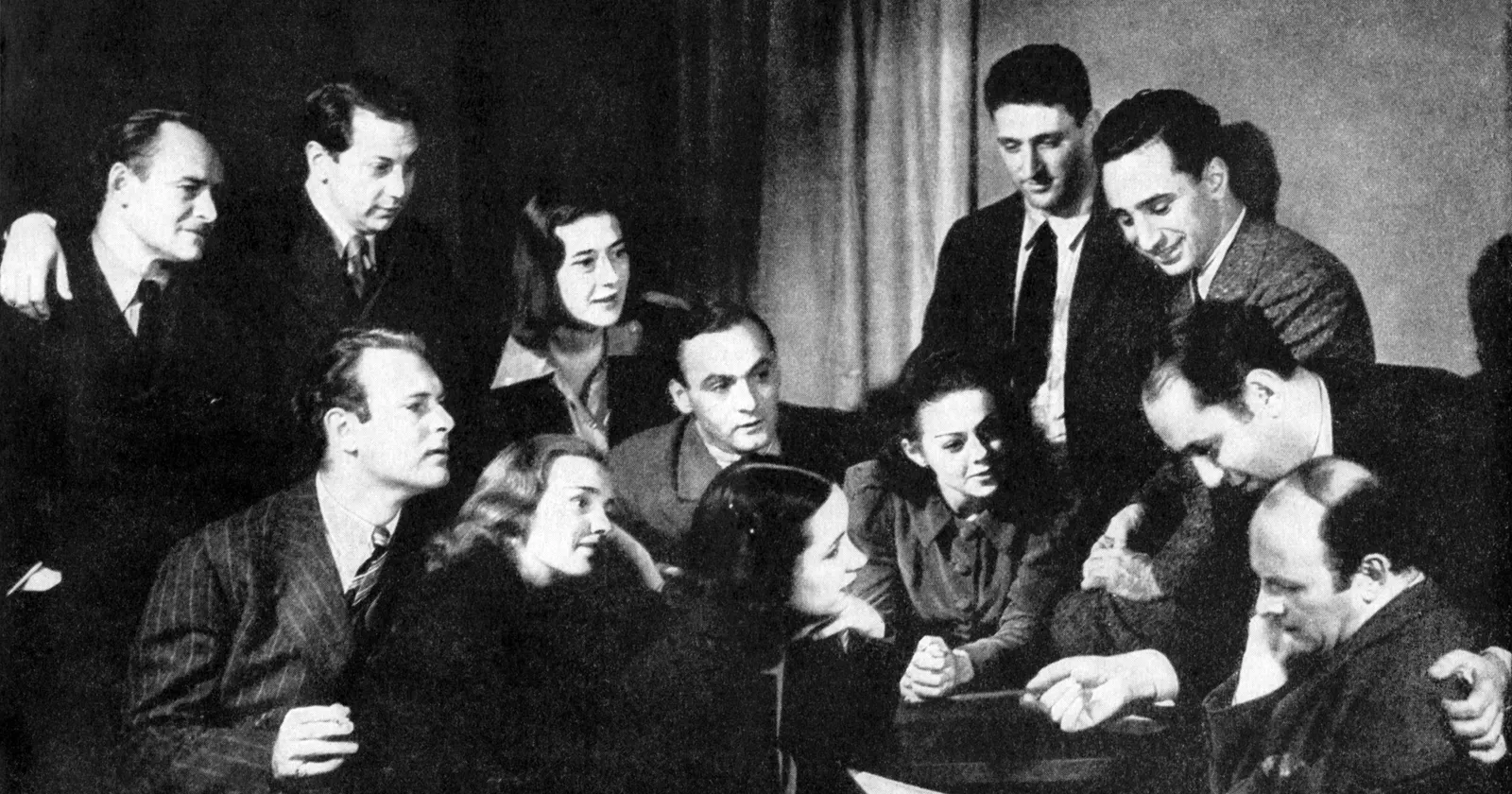
Sanford Meisner (1905-1997) was a founding member of the Group Theatre and, from 1935, head of acting at the Neighborhood Playhouse School of the Theatre in New York, a post he held for nearly fifty years.2 Over those decades he trained, among many others, Robert Duvall, Diane Keaton, Sydney Pollack and David Mamet, and built the technique that carries his name.1
Like Lee Strasberg and Stella Adler, Meisner started from the ideas Stanislavski's students had brought to America in the 1920s. The Group Theatre tested those ideas nightly through the 1930s, and its members drew different conclusions from the experiment, which ended up as three distinct ways of training an actor. Meisner's took shape at the Neighborhood Playhouse, in a two-year programme that became a benchmark of American actor training.7
He wrote and spoke little about himself. One book, Sanford Meisner on Acting, published in 1987, and a 1990 documentary titled, accurately, The American Theatre's Best Kept Secret: he let the school do the talking.2
What does "living truthfully under imaginary circumstances" mean?
It is Meisner's public definition of acting, recorded in Sanford Meisner on Acting. The weight of the phrase sits on living. The circumstances of a scene are invented, but the behaviour inside them is meant to be real, and the whole training exists to make real behaviour available on cue.3
The companion phrase in the same book is that "the foundation of acting is the reality of doing." An actor who is genuinely listening is not performing listening. An actor who really reads the letter on stage does not have to indicate reading it. The approach holds that feeling cannot be commanded directly, and that it arrives on its own when the actor is fully occupied with something concrete, most often the other person in the scene. Self-consciousness is the enemy, and attention is the cure.6
How does the repetition exercise work?
Two actors sit facing each other. One states an observation, "you're smiling," and the other repeats it from their side, "I'm smiling." The sentence passes back and forth, unadorned, and changes only when something in the partner's behaviour genuinely changes it. The exercise trains attention and response, not dialogue.4
Described on paper, it sounds like a parlour game of limited charm, and in the first weeks it is deliberately mechanical. Removing invented lines, cleverness and the obligation to be interesting leaves the actor with nothing to work from except what the partner is actually doing, which is the point. A smile, impatience, embarrassment: the same words change meaning on every pass. Playhouse students describe the first year as almost entirely exercise work.4
Over months, the exercise grows layers: an independent activity, a knock at the door, a reason to come in, an obstacle. Each addition keeps the original discipline, respond to what is really happening, and bends it toward the conditions of a scene.6 It trains two things that are hard to work on any other way: genuinely listening to your partner, and answering from what they have just done rather than from a prepared plan. Acting starts with the other person. That is the whole proposal.
How is it different from Strasberg and Adler?
The three teachers came out of the Group Theatre and split over the source of emotion. Strasberg looked for it in the actor's personal memory, Adler in imagination and the circumstances of the play, Meisner in the immediate relationship with the scene partner.3
Strasberg kept affective memory at the centre, the actor's own past recalled in detail to feed the present of the scene. Adler, after working with Stanislavski in Paris in 1934, replaced it with imagination and close study of the play's given circumstances, the direction Stanislavski's own system had ended up favouring. Meisner moved the source outside the actor altogether: self-attention cuts the actor off from the scene, so emotion has to arrive through the partner, by contact and response.
The disagreements were real, but the three systems are forks of one tree, taught today in the same cities and sometimes in the same schools, and plenty of working actors have trained in more than one. To place these three lineages among the other traditions, from Michael Chekhov to Brecht and Lecoq, our map of acting techniques and methods covers the full landscape.
Where is the technique taught today?
The Neighborhood Playhouse still runs its two-year programme in New York.7 Meisner-based studios operate in London, Los Angeles, Berlin, Sydney and most European capitals, and in France the technique has spread since the 2000s, usually as a complement to initial training for actors looking to recover spontaneity or loosen an over-controlled style.5
The name is not a protected trademark, so offerings range from faithful two-year progressions to weekend introductions, a distinction the established schools are usually the first to underline. The serious ones describe the same fixed order: repetition first, then activities and circumstances, written scenes last.
One practical limit: the repetition exercise cannot be done alone, it needs someone opposite. Between classes, what carries over best is the habit of attention to what you are really doing, which has its place in the routine every actor builds between two projects. Meisner liked to say that it takes twenty years to become an actor; the exercise was his wager on how to make the first two count.
Sources
- Meisner technique, Wikipedia, accessed October 2026
- Sanford Meisner, Wikipedia, accessed October 2026
- Meisner technique, Encyclopaedia Britannica
- The Role of the Repetition Exercise in Acting within the Meisner Technique, Maggie Flanigan Studio
- Méthode Meisner, Cours Les Insurgés (in French)
- The Meisner Acting Technique: a Complete Guide, Backstage
- The Neighborhood Playhouse School of the Theatre, official site
Frequently asked questions
Is the Meisner technique part of the Method?
It shares the Method's origin, the Group Theatre of the 1930s, but not its principle. The Method, in Lee Strasberg's sense, rests on the actor's affective memory. Meisner moved away from it and placed the source of acting in the relationship with the scene partner.
How long does it take to train in the Meisner technique?
The reference programme, at the Neighborhood Playhouse in New York, lasts two years, and the first year is almost entirely exercise work. Elsewhere, formats run from a weekend workshop to courses spread over several years. A short workshop gives a taste of the repetition exercise, not of the whole progression.
Can you practise the repetition exercise without a teacher?
You can practise it with a partner, but it needs someone opposite, and an outside eye helps spot when the sentence stops changing for real reasons. Schools present it as the first step of a guided progression, not as a stand-alone exercise.
Read next
Follow what we publish: @join_acto on Instagram.