In short
Spaced repetition means coming back to a text in several short sessions, at the moment it starts to fade, rather than working it in one block. For the same total time, it is one of the sturdiest findings in memory research, and theatre companies have been applying it for generations with the Italian run.
- Forgetting happens early: most of the loss comes in the first hours and the first days.
- Every return costs less than the last: this is what Ebbinghaus called savings.
- Four short sessions beat one evening, for the same number of minutes.
- The Italian run ticks every box: recall without the page, short sessions, gaps spread across the whole run of a show.
Berlin, 1885. Hermann Ebbinghaus spends months alone memorizing thousands of meaningless syllables, notes how much is left after twenty minutes, an hour, a day, a month, and publishes the first forgetting curve.1 The book founded a body of research that has kept confirming its central finding: memory lets go of what is not reactivated, and the timing of the reactivation matters more than its length.
For anyone with a script in hand and a shoot date in the diary, two of his observations are enough to change how the work gets done. Memory decays on a steep curve, most of the loss happening early. And repetitions spread over time hold the material better than the same repetitions packed together.
What does the forgetting curve show?
Without reactivation, retention drops fast, then more and more slowly: most of the loss happens in the first hours and the first days. Each relearning takes less effort than the one before, and each pass puts the curve back higher, with a gentler slope than last time.1
His material was deliberately meaningless, strings of letters chosen so that no association could help him. A script is the opposite case, saturated with meaning, intention and rhythm, which is why dialogue fades far more slowly than his syllables did. The shape of the curve, though, survives the difference. The losses concentrate early, and every return to the text after a gap costs less than the one before.
Ebbinghaus measured that economy with what he called the method of savings: the time saved when relearning a list already seen, compared with learning it the first time. The practical consequence can be read straight off the curve. Going over a text that is still fresh adds almost nothing; going over it once it has completely gone means starting again. The profitable moment sits in between, when the text is starting to slip and recall takes real effort. Contemporary research has a name for this, desirable difficulties: what costs you at the moment of recall pays you back at the moment of the scene.
What does modern research say about spacing?
The most cited synthesis, by Cepeda and colleagues in 2006, pools more than two hundred and fifty experiments on verbal memory run over a century.2 The result is among the most replicated in psychology: for the same total study time, spaced sessions produce clearly better retention than a single one.
The effect holds across ages, materials and protocols, and the same synthesis adds a useful point: the further away the deadline, the longer the ideal gap between sessions. A text that has to hold for a week is fine with short gaps; a part that has to hold for a season calls for returns spread over weeks. Ebbinghaus's curve described the loss. The research on spacing describes the calendar that works against it.
What does that look like with a script?
Four thirty-minute sessions spread across the week and one two-hour evening add up to the same working time. The experimental research nonetheless predicts two different texts: the first still available weeks later, the second already fraying after a few days.
The single evening feels better while it is happening, which is part of the trap. By the tenth pass the text comes easily, and that ease passes itself off as knowledge. Psychologists describe it as fluency masquerading as learning: what is being measured at midnight is familiarity with a page still warm, not the ability to pull the line up cold two days later in front of a camera.
The difference lies in the work each session demands. In the single evening, the last passes recite a text that is still warm, and memory has almost nothing to rebuild. In spaced sessions, each return finds a text partly faded and rebuilds it, and that rebuilding is what consolidates. A script lends itself to this all the more because it rarely serves a single deadline: a shoot stretches out, a run of performances goes on, a casting can call back weeks later. An actor's real deadline is almost always far off, which is exactly where spacing opens the widest gap. The whole of the work, of which spacing is only one piece, is mapped out in our guide to how actors learn lines by heart.
What happens at each successful recall?
Each time a line is successfully pulled back from memory after a gap, the next forgetting is slower. The curve flattens instead of resetting to its old steepness, which is why the gaps between reviews can grow, hours, then a day, then several days, without the text giving way.3
This is the detail that turns a psychology finding into a schedule. The second session can sit a few hours after the first, the third a day later, the fourth after a weekend, and each one is shorter than it would have been because savings are accumulating. The session still has to make the text come back, though: Roediger and Karpicke showed that recalling material consolidates it more than rereading it, for the same time spent.4
Language-learning companies have formalized exactly this, with models that estimate how each item is fading and time the next review accordingly; one published by Duolingo's researchers tunes the interval to each word's history.5 A script's lines fade at different speeds too. Everyone who has learned a part knows which three lines are always the ones missing in the morning.
Was the Italian run already spaced repetition?
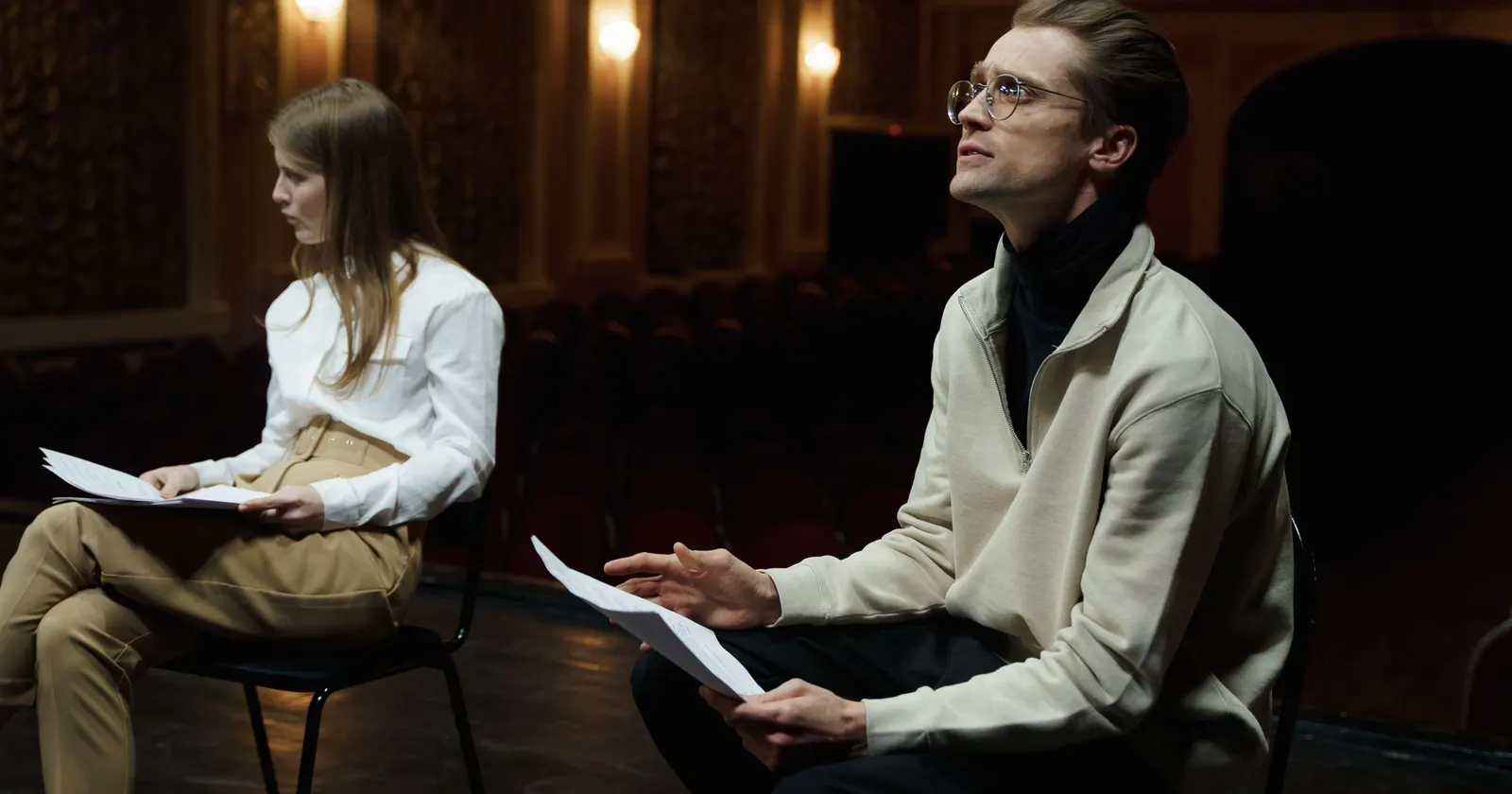
The Italian run, the text rattled off flat, with no acting and no movement, faster than in performance, has punctuated company life for generations: at the top of rehearsal, before a show, in a dressing room or a corridor.6 Those short passes, repeated over days or weeks, trace exactly the calendar the research on spacing describes.
Companies adopted it for practical reasons, checking the text, stripping away the intentions that pile up, tightening the collective rhythm, with no reference to experimental psychology, which the practice long predates.7 It ticks every box all the same: full recall rather than rereading, short sessions, gaps spread over the whole run of a show. A company that does its Italian run every day is applying Ebbinghaus's curve without ever having drawn it.
Ebbinghaus worked on meaningless syllables; actors work on meaning, rhythm and address. A hundred and forty years later, the rule he measured holds across both materials. When the deadline is three days away, the same logic plays out on a smaller scale, as set out in how to memorize lines fast.
Sources
- Hermann Ebbinghaus, Über das Gedächtnis, 1885 (English translation Memory: A Contribution to Experimental Psychology, 1913). Forgetting curve and method of savings
- N. Cepeda et al., Distributed Practice in Verbal Recall Tasks: A Review and Quantitative Synthesis, Psychological Bulletin, 2006
- Aaron S. Benjamin and Jonathan Tullis, What Makes Distributed Practice Effective?, Cognitive Psychology, 2010
- Henry L. Roediger and Jeffrey D. Karpicke, Test-Enhanced Learning, Psychological Science, 2006. Testing yourself retains better than rereading
- Burr Settles and Brendan Meeder, A Trainable Spaced Repetition Model for Language Learning, Duolingo Research, 2016
- L'italienne au théâtre, Cours Les Insurgés (in French)
- Filage, italienne, raccord : comprendre le travail au plateau, Cours Le Foyer (in French)
Frequently asked questions
How long should you leave between two sessions?
The right moment is when the text starts to slip without having gone. In practice, a second session a few hours after the first, a third the next day, then gaps of several days. The further away the deadline, the longer the intervals can grow.
Does rereading the script count as a spaced session?
Not really. What consolidates is the effort of bringing the text back, not the time spent looking at the page. A useful session starts with the page covered, and only opens the script to check what did not come.
Is the Italian run enough to learn a text?
No, it maintains a text that has already been learned. It checks that the text holds, works the joins between lines and reactivates it at regular intervals. The first learning happens in each actor's own work, before the company gets together.
Read next
Follow what we publish: @join_acto on Instagram.